What Is OOH Advertising? A Complete Guide to OOH, DOOH, Programmatic OOH, and Billboard Analytics
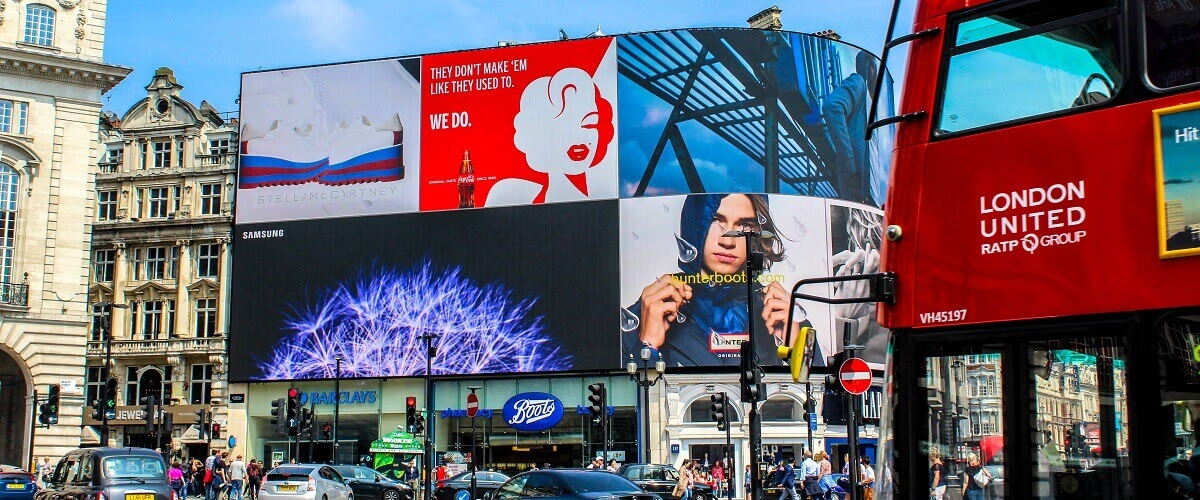
Out-of-Home (OOH) advertising is one of the oldest and most effective forms of media and today, it is evolving faster than ever. With mobile-data measurement, real-time reporting, and digital screens transforming how campaigns are planned and evaluated, understanding the different types of OOH is crucial for advertisers and media owners alike.
In this guide, we break down what OOH is, explain DOOH, programmatic OOH (pOOH), and show how billboard impressions, OOH attribution, and out-of-home analytics are reshaping the industry.
What Is OOH Advertising?
Out-of-home advertising also known as OOH advertising, encompasses any visual advertising media found outside of a consumer's home. This could be signage, billboards or any ads displayed in outdoor public spaces that garner a high level of traffic and people's attention. It is the oldest form of advertising and has been used for centuries to reach broad audiences across geographies. In recent years OOH advertising has also been one of the fastest growing ad mediums due to its ability to reach large audiences in high-traffic areas and innovations with digitalisation of billboards and programmatic buying. OOH provides advertisers with the unique opportunity to stand out from the noise of advertising on people's devices and meet them where they go daily, to the shops, work or commute.
A 2023 study by Nielsen found that OOH media has the highest recall compared to other advertising channels of 55% making it the best channel for brand building. This is because OOH ads are often large, visually striking, and placed in locations where people are more likely to notice them when compared to digital ads that can be easily ignored, scrolled past or blocked.
Some of the most common types of OOH advertising include:
- Roadside billboards
- Bus shelter ads
- Airport and shopping centre screens
- Mobile billboards (including rideshare, taxi-top screens and bus wraps)
OOH advertising works because it captures real-world attention in high-traffic areas, along commuter routes, and in environments where audiences are receptive to visual messaging than a social media ad.
The Rise of OOH Billboards
OOH billboards remain the most recognised format in the industry. They come in two primary categories:
1. Traditional OOH Billboards

These are static printed billboards that display a message 24/7. They remain a cost-effective and high-reach medium for advertisers.
2. Digital OOH (DOOH) Billboards

Digital OOH — often called DOOH — uses digital screens to display dynamic content. Brands can rotate creatives, run time-specific messaging, and respond to environmental triggers (e.g., weather, traffic, events). DOOH is the fastest-growing segment of the OOH market because it allows more flexibility, higher creative impact, and better integration with real-time data.
What Is Programmatic OOH (pOOH)?
Programmatic OOH (pOOH) — also known as programmatic DOOH — refers to the automated buying, selling, and optimisation of digital OOH inventory using software platforms and data-driven decision-making.
Unlike traditional OOH buying, which involves manual negotiations and long-term contracts, programmatic OOH uses technology similar to online display advertising. Advertisers can bid on digital billboard space in real time, target specific audiences, and adjust campaigns dynamically based on performance data.
How Programmatic OOH Works
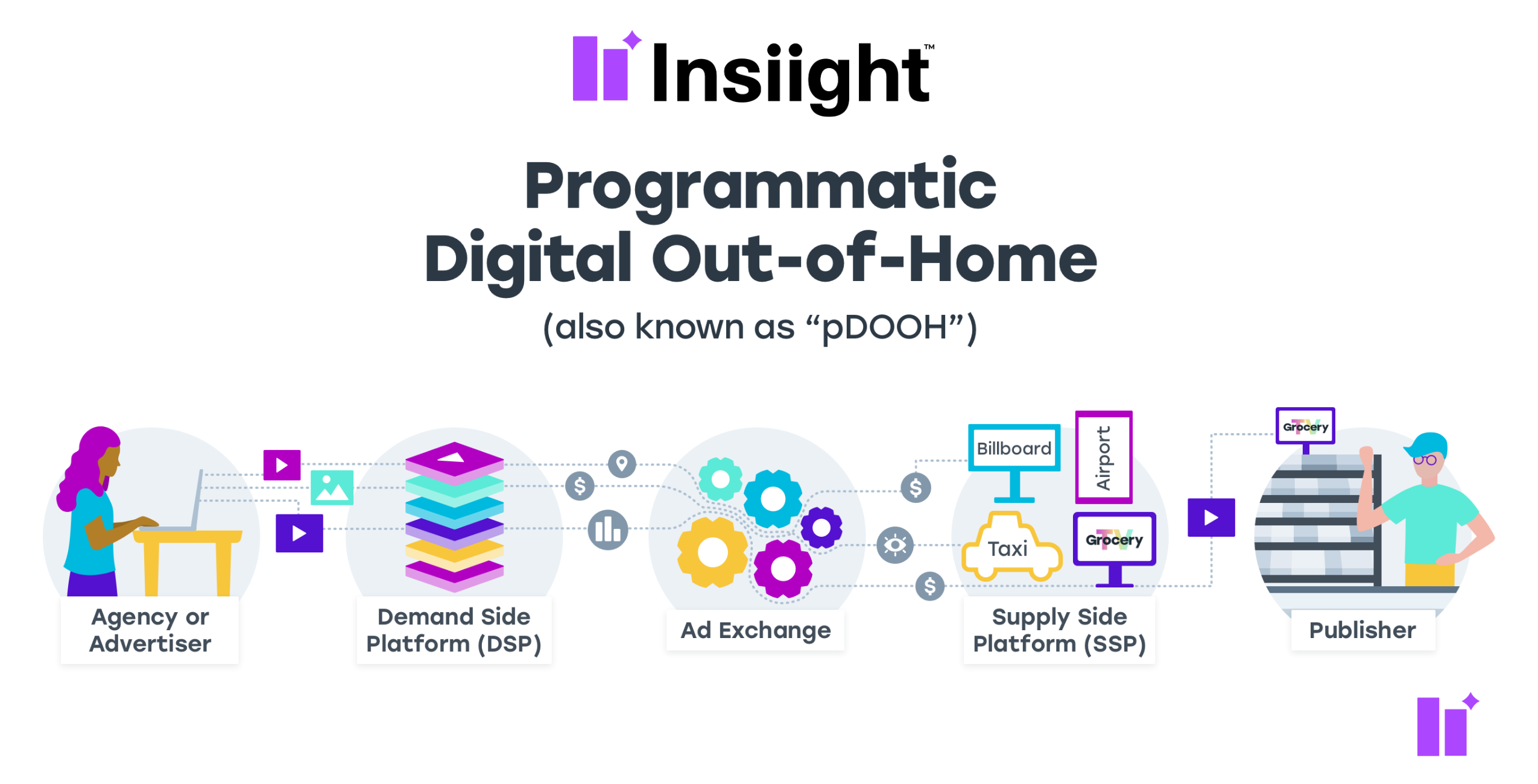
The programmatic OOH ecosystem operates through several key components:
- Demand-Side Platforms (DSPs): Where advertisers and agencies buy inventory and manage campaigns
- Supply-Side Platforms (SSPs): Where media owners list and sell their digital screen inventory
- Ad Exchanges: Digital marketplaces that connect DSPs and SSPs, facilitating automated transactions
- Data Management Platforms (DMPs): Systems that process audience data to enable better targeting
Leading platforms like Hivestack and Perion have pioneered programmatic DOOH technology, making it easier for media owners to monetize their digital screens and for advertisers to execute data-driven OOH campaigns at scale.
Key Benefits of Programmatic OOH
Instead of purchasing static billboard placements for fixed periods, advertisers using programmatic OOH can:
- Audience-Based Buying: Purchase impressions based on who is actually present, not just location
- Dynamic Targeting: Target specific demographics, behaviors, or times of day with precision
- Real-Time Optimisation: Adjust creative, budgets, and placements during live campaigns
- Triggered Campaigns: Activate content based on live data inputs like weather, traffic, sports scores, or stock prices
- Flexible Budgeting: Buy inventory in shorter time increments rather than week or month-long commitments
- Transparent Reporting: Access detailed performance metrics and impression data in near real-time
pOOH brings digital-style efficiency, automation, and precision to the physical world — transforming billboards from static assets into responsive, data-activated advertising channels.
Transit and Bus Shelter Advertising

Transit advertising includes ads on buses, trains, taxis, and at transit stations. These formats are particularly effective for reaching commuters and urban audiences with high frequency.
Why OOH Analytics Matters More Than Ever
As the advertising industry becomes increasingly data-driven, OOH analytics has transformed from a nice-to-have into an absolute necessity for media owners and advertisers who want to remain competitive.
For decades, traditional OOH relied heavily on estimated traffic counts and theoretical visibility studies, methodologies that couldn't prove who actually saw a billboard or what happened after exposure. Today's advertisers, accustomed to granular digital metrics from platforms like Meta and Google, demand the same level of transparency and accountability from their OOH investments.
Modern out-of-home analytics platforms powered by mobile device data now provide:
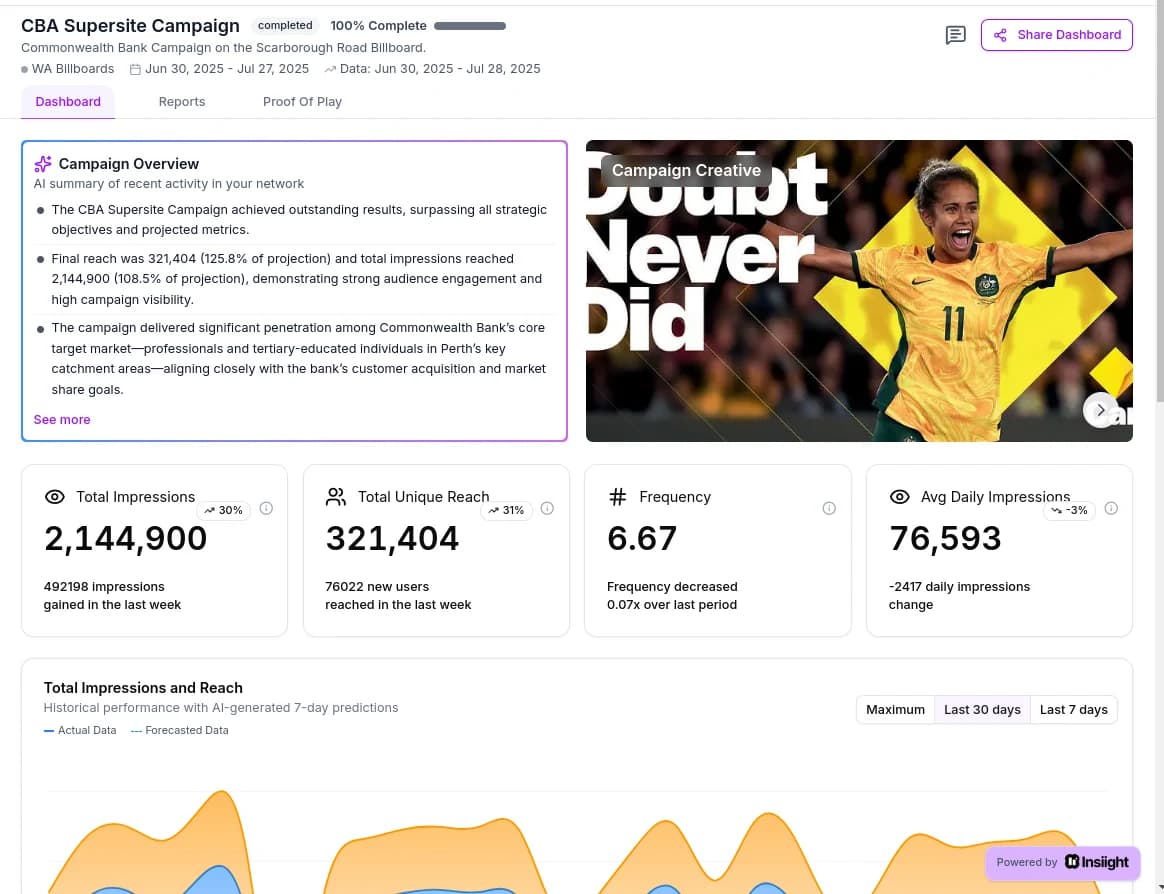
- Billboard Impressions: Actual measured exposure based on real human movement patterns near OOH assets
- Unique Audience Reach: Deduplicated counts showing how many individual people saw your billboard
- Demographic Segmentation: Detailed breakdowns by age, gender, income, occupation, education, and more
- Movement Heatmaps: Visual representations of where audiences concentrate and how they flow through areas
- Behavioral Insights: Understanding audience interests, shopping patterns, and lifestyle characteristics
- Predictive Modeling: Forecasting future campaign performance based on historical audience data
- Competitive Benchmarking: Comparing performance across different sites and market conditions

Modern OOH analytics works by detecting anonymised mobile devices within a billboard's visibility cone, the geographic area where the billboard is actually viewable. Only devices that enter this cone are counted as impressions, ensuring accurate measurement of real exposure rather than simple proximity or traffic estimates.
From Assumptions to Evidence-Based Planning
The impact of mobile-powered OOH analytics extends far beyond reporting. Media owners can now answer questions that were previously impossible to address with certainty:
- Which billboards reach the highest concentration of a specific demographic?
- What time of day delivers the most valuable audience impressions?
- How does audience composition change seasonally or during special events?
- Which locations provide the best incremental reach for a multi-site campaign?
With advanced analytics platforms like Insiight Analytics, billboard owners can deliver real, measurable value backed by actual audience data rather than outdated assumptions. This data-driven approach not only justifies pricing but helps win more campaigns by speaking the performance language that agencies and advertisers now expect.
Why OOH Is Becoming a Performance Channel
The convergence of DOOH technology, programmatic buying platforms, real-time billboard impressions, OOH attribution models, and sophisticated out-of-home analytics has fundamentally transformed OOH into a channel that can finally compete with digital when it comes to measurement and accountability.
For decades, OOH was viewed primarily as a brand awareness channel, impossible to measure with precision and difficult to justify with hard performance metrics. Today, that perception is rapidly changing as data-driven capabilities unlock new possibilities for media owners and advertisers alike.
Media owners who leverage analytics platforms like Insiight can now deliver measurable value through:
- Data-driven campaign proposals that win more pitches by demonstrating exactly which audiences each billboard reaches
- Transparent weekly reporting that provides advertisers with the same visibility they expect from digital channels
- Real, verifiable metrics that defend pricing decisions and prove ROI to skeptical buyers
- Precise audience targeting showing advertisers exactly who they reached, when, and with what frequency
- Performance optimization insights that help improve future campaign planning and creative effectiveness
- Attribution modeling that connects billboard exposure to downstream actions like store visits, website traffic, and conversions
OOH is no longer just a static branding medium — it has evolved into a performance ecosystem with actionable insights that allow advertisers to measure impact, optimize spend, and scale campaigns with confidence. This transformation positions OOH as a critical component of integrated, multi-channel marketing strategies rather than an optional brand-building add-on.
How Insiight Analytics Supports the Future of OOH
Insiight Analytics provides:
- Real-world audience analytics using anonymised mobile signals
- Billboard impressions and reach measurement
- Detailed demographic insights
- Campaign reporting for agencies and advertisers
- OOH attribution tools
- Planning and forecasting tools for future campaigns
Whether a media owner runs traditional billboards, DOOH screens, mobile OOH assets, or taxi-top displays, Insiight helps them turn their inventory into a data-driven performance product.
Final Thoughts
OOH advertising has entered a new era, one where data, analytics, and attribution matter just as much as creative design and location.
As digital and physical channels converge, the ability to measure audiences accurately and deliver actionable insights will determine which media owners thrive.
If you're a billboard or OOH media owner looking to elevate your offering with real-time analytics, audience insights, and accurate billboard impressions, Insiight Analytics can help you deliver smarter, data-driven results.
Ready to Transform Your OOH Business?
Start measuring real audiences, delivering accurate billboard impressions, and winning more campaigns with data-driven insights.